Ban Single Use Plastic
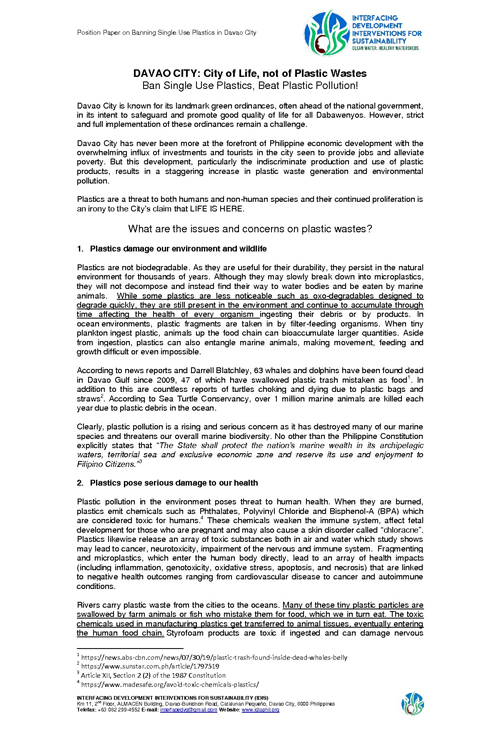
DAVAO CITY: City of Life, not of Plastic Wastes
Ban Single Use Plastics, Beat Plastic Pollution!
No to Reclassification of Agricultural Lands and Water Zones
IDIS, along with other CSOs, participated in the series of workshops for the updating of Davao City’s Land Use Plan The City Government of Davao’s land use plan is focused on decongesting the city’s urban center. While this is a welcome development, the City should ensure that environmental critical areas and green zones outside the current urban district remain protected and will not be compromised in the development process. Davao has decided to retain among its top priorities food security and ecological protection by maintaining 60% of the city’s land area to be devoted for agriculture. To achieve this shared goal, these two should be non-negotiable for reclassification: Agricultural to non-agricultural conversion As the City gears towards continued development, high premium must be placed on our agricultural lands. They shall be protected by all means necessary, to ensure food supply and food security for Dabawenyos. The City through the Comprehensive Land Use Plan and Zoning Ordinance should restrict land conversions especially agricultural areas to non-agricultural. One concrete example would be the existing Gaisano Grand Mall in Calinan. The building has affected farmlands which could have yielded the city a more economically beneficial if its original use to ensure rice and food supply was retained. We further recommend that the City should: Map productive and non-productive agricultural areas in Davao City and strictly prohibit reclassification of productive agricultural areas. For non-productive areas, a recommendation for its reclassification can only be made if there is proof for a need to reclassify the same. Aspire to increase the production of food crops such as rice for local consumption; Identify more areas to be declared as organic agricultural (OA) zones, provide appropriate support for organic farmers to increase production and market opportunities, and establish more buffer zones in these zones to protect them from contamination; and Due to the rise of demand of reclassification appeals from homeowners’ associations applying for socialized housing, encourage settlement build up only in existing Rural Settlement Zones (RSZ) to protect prime agricultural areas to be reclassified. The government should survey lands/prepare clustered areas for socialized housing and relocation, rather than scattered separate sites. Water resources zone to other allowable uses Water Resource Zones are crucial for Davao’s sustainable water supply. These are areas on top of identified locations of principal source of drinking water where Davao City Water District has existing or planned production wells within 350-meters buffer zone. Granting of additional allowable use is prohibited in these zones so applications for allowable use within/near these zones should never be approved nor entertained in the first place. Sadly, there have been applications that were approved including those projects in high density residential zones. Thus, we recommend that: The definition of a Water resource Zone should not be limited to DCWD-covered areas with existing, planned or proposed production wells but should be expanded to include other areas which may have water resources; The 350-meter buffer area provision be increased/stretched since this current figure is insufficient to prevent damage/harm to water resources; and The Local Zoning Board of Adjustment and Appeals should refrain from recommending to the City Council applications for additional allowable use which are clearly within or near a water resource zone Download our full position paper on the CLUP and Zoning Ordinance here.
International Day of Biodiversity
The United Nations has proclaimed 22 May the International Day for Biological Diversity to increase understanding and awareness of biodiversity issues. The theme of the 2019 edition will be ‘Our Biodiversity, Our Food, Our Health’. “How food is produced, what is consumed, and how much is lost or wasted all heavily shape the health of both people and planet” – Food Planet Health by EAT-Lancet Commission 2019 We can focus on production (sustainable food production) and final consumption (healthy diets) to help protect our forest and agrobiodiversity. Locally produced, organic products support our local farmers and benefit our health and the environment. Hence the Philippines enacted RA 10068 An Act for the Development and Promotion of Organic Agriculture in the Philippines. official zlibrary domain z lib . Find free books
May is the Month of the Ocean
Where does our single-use plastic end up? In March 2019, a cuvier beaked whale was found dead in Compostela Valley containing 40 kilos of garbage: 16 rice sacks, 4 banana plantation bags and multiple shopping bags. Plastics have long lifespans and can travel from the uplands through rivers and downstream into our oceans, where marine animals accidentally mistake them for food, choke or get sick by ingesting them. Plastics then find their way back to us, in less visible form (microplastics), when they are consumed by fish that we in turn eat. The plastics we produce, consume and do not dispose properly pollute our lands, damage our oceans and our health.
Bantay Bukid Report for 1st Quarter 2019
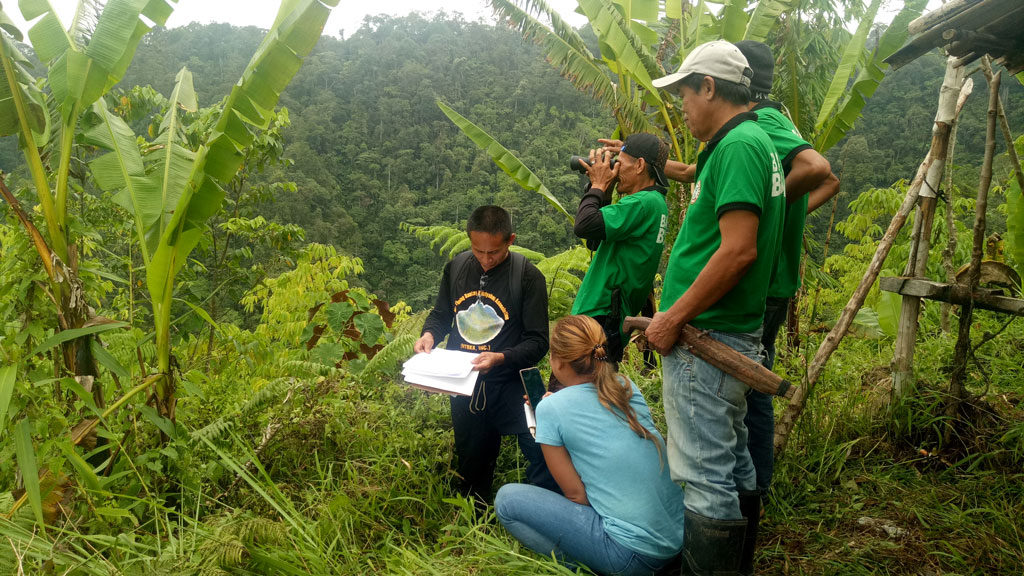
To start the year, 71 Bantay Bukid volunteers conducted biodiversity monitoring, with an increase in the number of species recorded compared to last quarter’s patrol. They planted over 800 seedlings in our riverbanks and monitored previously planted areas to replace seedling mortality due to El Niño. They also continued protecting our river waters from waste pollution, collecting up to 110 kilos of garbage from 4 clean-up drives. Our volunteers likewise committed to help in the monitoring of the reported Tabak – Kalatong illegal entry, occupation and poaching in the ancestral domain of the Obu-Manuvu in Brgy. Carmen. Enforcement on Environmental Laws – one incident of illegal fishing violating the City’s Watershed Code reported in March documented Biodiversity Monitoring and Reforestation – Trek to Mt. Tipolog last March 2019 showed sixty six (66) species of trees and plants, forty (40) species of mammals, five (5) species of birds, one (1) species of amphibians identified using their local terms. River Monitoring – Amount of garbage collected in riverbanks more than doubled with 110 kilos compared to last year’s 43 kilos. The water quality in Panigan-Tamugan river remains to be of high quality Class A based on the community-based water monitoring measuring basic parameters. Organizational activities and Community Action – 7 Organizational Activities, 8 LGU/Community Activities, 4 Participation to CSO events including bayanihan to clear trails for students/farmers and help in securing water for community, participation to BLGU flag ceremonies for watershed reporting/updating, planning for Davao City integrated watershed management and zero waste month celebration. For government action: Establishment of materials recovery facility and garbage collection points Strict implementation and monitoring of Solid Waste Management and other ordinances in watershed areas Kalatong-Tabak tree poaching and illegal entry Read the full report.
BK on Public Parks

Improving public parks and developing more accessible green open spaces in Davao.